
Rambo 3 story
First—the poster. Desert heat, a chopper burning somewhere in the distance, and Sylvester Stallone with that legendary bow, arrow tipped with explosives and ready to fly. Riding that cinema boom came Rambo III—the very same “Rambo 3” on Sega, a film tie-in where you don’t just watch, you step forward—and you’re in Afghanistan, right in the heart of an ’80s actioner. And even if the cart more often flaunted the movie cover than screenshots, the game had its own magic: power on—and you’re “Rambo on the Mega Drive,” a hero for whom one magazine is never enough.
How the movie turned into “playing as Rambo”
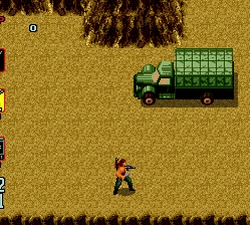
Licenses for hot premieres flew faster than bullets, and Rambo III embodied that sprint: the devs had to bottle the film’s pacing—dash, breach, rescue—into a living-room action game. Hence the top-down run-and-gun: you blitz through camps and caves while the screen shudders with explosions. And to make the film’s vibe sing beyond that punchy ’80s action score, they added set pieces—an on-rails, first-person shooting scene with the iconic bow. Crosshair in frame, outposts on the skyline, and you can almost feel the string snap. On paper it’s just “Rambo 3 for the Sega Mega Drive,” in practice—it’s the movie distilled into a cartridge.
Under the hood it had its own quirks, but for us players something else mattered: Rambo III spoke fluent adrenaline. No Russian localization—and none needed. The story reads in a blink: “pull Troutman out, survive, blow half the place sky-high”; the recognizable silhouette of a Mi-24 on the horizon, tented field camps, night raids—straight from that VHS era when tapes spun in every neighborhood. We called it all sorts of names: “Rambo III,” “Rambo 3,” or just “Rambo on Sega,” but the point was the same—boot it up and live the action yourself.
How the game spread worldwide—and to us
While stores in the West sold it with a big name and a glossy box, over here Rambo 3 followed its own path. Bootleg carts with loud stickers, market stalls where “Mega Drive” sounded like a magic spell, and that passed-around “16-bit classic.” Video parlors argued about the film—at home we argued about routes: how to slip past a camp, where to save grenades, when to draw those explosive arrows. That was the power of it: Rambo III became a shared story, a living-room legend for a crew of friends, where everyone knew when to turn and when to hold forward.
Versions existed in parallel on other systems—each port reimagined the film its own way. But Rambo 3 on Sega held the line as a “no-nonsense arcade shooter”: no fluff, straight into the fight. The format proved durable: simple goals, tight tempo, instantly recognizable set pieces. And years later, when someone asked, “So what’s Rambo 3 on Sega?”, the answer stayed steady—the top-down shooter where you push forward and never look back. We packed the hands-on feel into a gameplay breakdown—take a look at /gameplay/.
The secret to why we love it is simple: the game gives exactly what we come to Rambo for. The music pumps, the screen is drenched in muzzle flashes, and you’re always on the edge—almost like in a theater, except here your mistake costs you a real chance. And every time that rotor thrum rolled across a level, it felt like you were back in a seat: fists clenched, breath short, just make it to the next checkpoint. That honest, unshowy link to the film is what made Rambo III on Mega Drive “that Rambo game.”
Why “Rambo 3” sticks so hard in memory
Because it’s not just a movie tie-in—it’s a memory button. Slot in the cart and you’re back in a world that reads without words: we save our guy, blow the bridge, slip out under fire. For some it was the first shooter on Sega; for others—a neighbor’s console and a whole evening with one pad, taking turns. Everyone has their own angle, but the shared picture is the same: Rambo III as a slice of common culture, from VHS tapes to cartridges. Even today, say “Rambo 3 on Sega” and you don’t recall the level count—you feel it: warm plastic, the click of a button, and you’re back with a bow that whispers “aim higher.”
And there’s more—it’s that rare case where “cult film” and “cult game” fused without friction. The phrase “a Rambo game” needs no explanation, and “Rambo III” sounds like a password for anyone who remembers that look: sand, steel shadows, the fiery arc of an explosion. Maybe that’s why different names stuck—some say “Rambo III,” some “Rambo 3,” and sometimes you hear the fond “Rambo on the Mega Drive”—and every time you know exactly what they mean. That’s the best compliment for a game: you don’t retell it, you recognize it from a few notes and a single bow-drawn silhouette. If you’re itching to dig deeper into the era and its games, drop by /history/—same air, just more pages.